On December 13, 2025, National Review published an essay by me on Frank Gehry’s legacy, including the National Eisenhower Memorial.
The Complicated Legacy of Frank Gehry’s Work
The legendary architect, who died last week, was an artist of self-expression.
Frank Gehry, the most famous and lauded architect in America, died last week at the age of 96. He exemplified the “starchitect,” a heady mix of celebrity, brand-name design, and signature aesthetics meant to wow. With perhaps false modesty, he complained about being “geniused to death.”
Based in Los Angeles, where he was immersed in the hipster art scene, he was so well known that he played himself in a cameo on The Simpsons, designed concrete cufflinks for Tiffany & Co. and a silly hat for Lady Gaga, and was mentioned by Hillary Clinton in 2013 in a cryptic comment on the need for a new international order: “We need a new architecture for this new world, more Frank Gehry than formal Greek.”
It is wrong for traditionalists, whether in politics or architecture, to reflexively dismiss Gehry. Popularity ought not to breed contempt, and the domain of architecture is capacious enough to contain singular, yes, geniuses. Consider that, while overall critical, the conservative philosopher Roger Scruton had some positive things to say about the modernist Mies van der Rohe. The challenge, however, is to remember that exceptions like Gehry ought not to set the rule. The cult of genius that the architect triggered caused a plague of alien buildings that look like they landed from outer space: object buildings meant to shock, ignoring urban context and shirking the responsibility to build human settlements that serve the common good. None of this starchitecture, including Gehry’s, contributes to or harmonizes with the urban fabric.
Gehry said, “I try to rid myself and the other members of the firm, of the burden of the culture. . . . There are no rules, no right or wrong. I’m confused as to what’s ugly and what’s pretty.” In his hands, he could — at times — make this aesthetic anomie work (putting context aside). In the hands of mere mortals, failure is mostly inevitable. As the Romans would say, “Quod licet Jovi, non licet bovi.” (“What is permissible for Jupiter is not permissible for an ox.”)
Although uneven in his output, at its best (as in the dynamic Guggenheim Museum Bilbao and billowing Walt Disney Concert Hall in L.A.), he was a magician conjuring radical new forms suggesting many simultaneous meanings: sails, fish, whales, flowers, artichokes, knife blades. His playful alchemy incorporated materials and techniques such as warped stainless-steel panels that could be constructed only with the help of aerospace computer technology. (He himself was a pilot and sailor.) His works could be exuberant and ethereal, achieving a feeling of lightness, as in his Fondation Louis Vuitton, despite their size. They also sometimes combine menace and joy, as in the “Fred and Ginger” Dancing House in Prague, where the external rebar in “Ginger’s” body is tortured by what appears to be crushing force from her dance partner pulling her waist toward him. At their worst (as in the Museum of Pop Culture in Seattle), his buildings are jumbled mishmashes of colliding forms that look like the crumpled aluminum foil in parodies of his work.
To his credit, his Bilbao Guggenheim — an explosion of shimmering curved titanium tiles reminiscent of a whale the size of the Leviathan — was the first popular avant-garde building of its era. Over 2 million people visited it in its first two years. Seventy percent said they came to see the building rather than the art it contained. The building thus served a purpose other than being an economic boon to the rusting, post-industrial city. (Most other cities that tried to copy the so-called “Bilbao Effect” resulted in economic failure.) Like other contemporary architectural spectacles intended to serve as museums, the building is more moving and beautiful than the forgettable contemporary art within.
But the biggest criticism one can make of Gehry is that he was in the wrong line of work. He was a talented expressionist sculptor, not an architect. In his own words: “I said to myself, ‘Artists have trouble with scale in the city because the city is such a large scale. No one ever commissions artists to make sixty-story sculptures, and until one of them makes a sixty-story sculpture, their works will not stand beside the Empire State Building and mean anything.”
He repeatedly said he wished he had been an artist: “If I have a big envy in my life, it’s about painters. I wish I was a painter. . . . There’s the canvas, it’s on your easel, you got a brush and a palette of colors, and what do you do? What’s the first move? I love that dangerous place.” It seems that Gehry was turned astray from his true vocation by his college ceramics professor, who encouraged him to leave art for architecture. Despite de facto being a sculptor by profession, painting was always his biggest artistic influence.
Gehry is also to be commended for rejecting the architectural modernism in which he was schooled. It was his discovery of the great medieval churches of Europe that led to his conversion. His architecture school, he said, “had only a token class in architectural history and a token class in art history at USC at the time. Modernism was the mantra, and I bought into that. That’s how I was trained. When I went to Paris in 1960, I looked at things every weekend. That’s when I saw the great cathedrals — Notre Dame, Chartres, and others — and I thought, Holy sh**, I’ve been had.” His subsequent work represented not a return to history (other than the influence of the Baroque architect Borromini, with his convulsing geometry), but it demonstrated that modernism had come to a dead end.
Despite the modernist commandments, Gehry spurned any attempt to follow the purported Zeitgeist: It was his spirit he followed, not that of the times. He also rejected the dictum that “Form follows function” — the modernist idea that the form of a building is to be determined solely by its purpose. Gehry’s buildings look nothing like their program. In addition, instead of rigid modernist rectilinearity, his shapes went to the opposite extreme: non-Euclidean, swooping, curving, crushed, distorted. Abandoning modernist puritanism — restrained in color, form, and materials — he was licentious.
Some of his experiments in design were functional failures: The Disney Concert Hall burned passersby with 140-degree death rays, the MIT Stata Center leaked and cracked so badly that there was a large lawsuit that settled out of court, a building at Case Western Reserve University dropped perilous snow and ice on visitors, and the interior of his crumpled Lou Ruvo Center for Brain Health disoriented the neurologically impaired patients. Dysfunction followed dysform. “Life is chaotic, dangerous, and surprising. Buildings should reflect that,” he said. At times, the danger was made literal.
Like many modern artists, Gehry was autobiographically driven, using his past and his (sometime tortured) psyche as his material. For instance, Gehry (né Goldberg) said his frequent use of fish forms derived from his memories of the live carp his grandmother would keep in the bathtub for preparation as gefilte fish. His self-renovated house — incorporating rebarbative cheap corrugated metal, chain link, and plywood — was inspired by his experience in his working-class grandfather’s hardware store.
Art and architecture was for Gehry a form of self-expression, which explains why he was such a poor choice for his only completed project in Washington, D.C.: the National Eisenhower Memorial. Gehry the self-portraitist agreed to take on the task of capturing the essence of someone else, someone far different. It was an odd pairing. The flamboyant Southern Californian was required to lionize a stolid Midwesterner who hated modern art. Just as bad, the purveyor of architectural chaos was working in a city hallmarked by classical order.
From their very first meeting, the organizers of the memorial said they wanted someone like Gehry to design the memorial. And lo and behold, years later he “won” the invitation-only competition that had only 44 entrants. A House Oversight investigation into the competition later found that the jury was unimpressed by the finalists, which included Gehry. In the jury’s words, “None of the visions expressed the whole essence of Eisenhower. The schemes as presented were mediocre for such an important memorial.” Nonetheless, a subsequent evaluation board would give Gehry the job for reasons that have never been made clear.
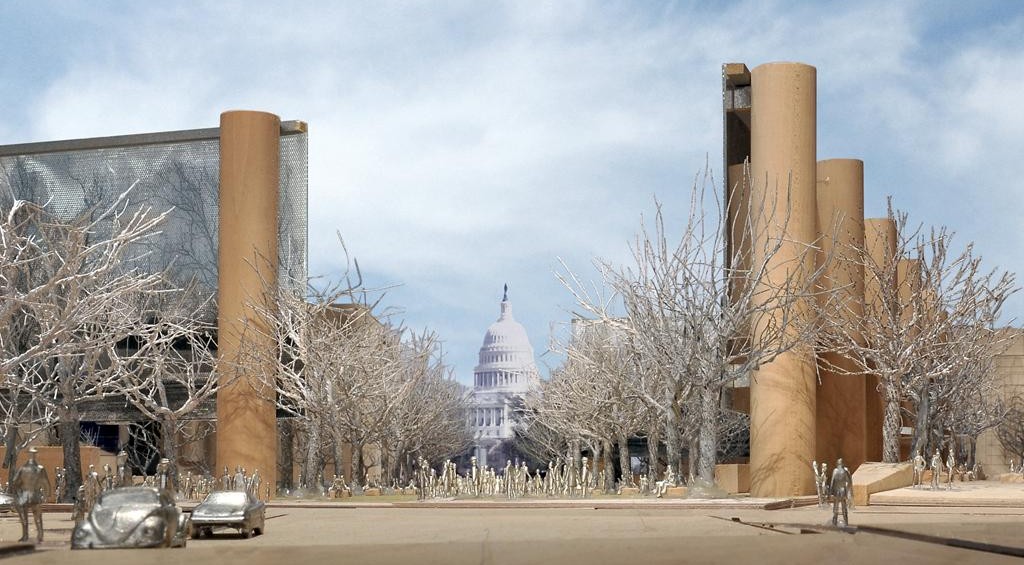
After Gehry unveiled his design in 2011, a major controversy exploded with fierce opposition from members of the Eisenhower family, Congress (both Democrats and Republicans), and architectural traditionalists. The initial design consisted of three 80-tall steel “tapestries” (woven screens) with the largest being 450-feet long upheld by equally tall ten-foot-wide stone-clad cylinders. The two smaller tapestries, set at right angles to the ends of the main tapestry to form a kind of square landscaped plaza, were each bigger than a basketball court and blocked the viewshed to and from the Capitol. The tapestry screens depicted the Kansas landscape in winter (Ike’s home state), a bleak anonymous scene that might as well have been Kazakhstan.
Perhaps most outrageous, the sole statue of Eisenhower, sited on the ground at the center of the main tapestry, depicted him as a life-size seven-year-old barefoot boy seated on a plank — inspired by Eisenhower’s first political speech after returning from World War II, in which he reminisced about “the dreams of a barefoot boy.” (Eisenhower would later admit his speech was hokum.) The design was topsy turvy its in scale and symbolism, and it intensely clashed with the heroic classical memorial tradition in the capital. The design, essentially with a void at its core, was attacked for being a monument to Gehry himself.
Congress held up all funding for four years, a bill advanced from committee that would have effectively killed the design, and the scheme was pilloried by the U.S. Commission of Fine Arts and National Capital Planning Commission. The New Yorker reported that the design “managed to achieve something rare in Washington: in true bipartisan spirit, almost everyone hates it.”
Ultimately, Gehry was forced to remove the two smaller tapestries (leaving two free-standing cylinders like smokestacks) but threatened to strip his name from the memorial if the main tapestry was eliminated. He also added figurative statues to his design: wooden, hyper-literal tableaus of Eisenhower as president and Supreme Allied Commander. The barefoot boy was replaced by a statue of a teenage Eisenhower, with odd orangutan proportions, shunted off to a corner.
The impasse only came to an end when former Secretary of State James Baker brokered a backroom deal with the Eisenhower family. The Kansas landscape was replaced by a depiction of Normandy Beach in the present day, which satisfied the Eisenhowers who wanted more emphasis on the president’s accomplishments. They dropped their opposition, and therefore so did Congress. Gehry was not even a party to the compromise negotiations.
In the end, the memorial opened in 2020 at a cost of $145 million, with just $15 million from private sources — this despite the fact that the Eisenhower Commission initially said only 20 percent of the cost would be paid with tax dollars. Gehry, whose name is inscribed on the memorial, did not speak at the opening ceremony.
When you visit during the day, the image on the tapestry — a scribble scrabble sketch by Gehry himself—is not even apparent. At night, when the screen is illuminated, it is impossible to tell what is depicted other than abstract expressionism with Gehry’s “signature” hand-drawing on it.
Reviews of the memorial have not been kind. New York magazine’s Justin Davidson, despite being highly sympathetic to Gehry’s oeuvre, called the design “a wan anticlimax . . . a work of civic architecture that fails to quicken the patriotic pulse or add much to the landscape of memory in downtown D.C.” Edward Rothstein likewise panned the design in the Wall Street Journal: “Some objects are inflated beyond all significance; others are so diminished they seem afterthoughts.”
But the most important review is the saddest one: Few people ever visit the memorial, despite its prime location across the street from the National Mall and Air and Space Museum, which gets 3 million visitors a year.
In his otherwise idolizing biography of Gehry, Paul Goldberger, addressing the memorial fight, wrote that the architect “felt few people in the architecture community seemed willing to defend him. . . . Frank, anxious as ever about his reputation, did not consider the possibility that many of his peers were simply not enamored of the memorial design, and that it was their architectural judgment, not any lack of loyalty, that was preventing them from speaking out. For all his lifelong worry about what people thought of him, it did not occur to him that the architects he respected, and who he knew respected him, might have simply viewed this one as a miss, as one of those moments when Babe Ruth strikes out.”
All of this raises the question: Why did Gehry not pull out? Why fight Congress, the family, and public opinion? Why accept this compromise? In 1964, Franklin Delano Roosevelt’s family denounced the selected design of the FDR memorial saying that they hated it, and the president would have hated it too. Not long after, the architects graciously resigned from their commission.
Can one attribute Gehry’s stubbornness to arrogance, to hubris? Or could it be that on that huge tapestry, he finally got what he wanted his entire professional life: a canvas with a painterly illustration in his own hand?