President of the National Civic Art Society, a non-profit organization headquartered in Washington, D.C. that promotes the classical and humanistic tradition in public art and architecture. Eleventh Chairman of the U.S. Commission of Fine Arts, an independent federal agency comprising seven presidential appointees who are the aesthetic guardians of Washington.
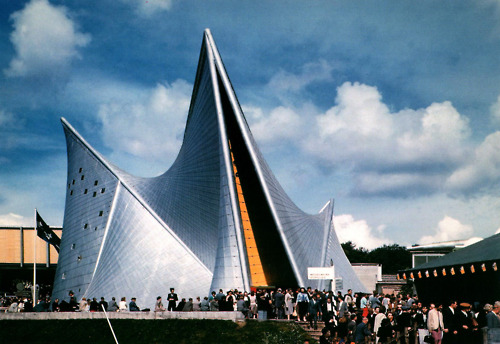
Goethe famously said that “Architecture is music frozen in time.” Expressing that literally, Le Corbusier and composer Iannis Xenakis co-designed the Philips Pavilion for Expo ’58 in Brussels. In particular, the hyperboloid building, shaped like a stomach, was inspired by Xenakis’ scratchy composition Metastasis (listen). “Metastasis” means “the spread of a disease from one organ or part to another non-adjacent organ or part.” (Is this what the Dutch electronics company had in mind?) As visitors entered and exited the pavilion, they heard a recording of Xenakis’ Concret PH, which is nothing but the noise of burning charcoal (listen). Xenakis described the projected sound as “like needles darting from everywhere.” Cutting edge, indeed. In the interior, visitors heard Edgard Varèse’s disjointed piece Poème électronique, which was specially written agglomerated for the pavilion (listen). I commend the composers for accurately capturing Le Corbusier’s architecture in sound.
Philips Pavilion at Expo ’58 – Architects Le Corbusier and Iannis Xenakis
Writing for The New York Times, Robert Beaser, a professor and chairperson of the composition department at Juilliard, explains how classical architecture in Rome inspired him to reject the barrenness of Modernism in music.
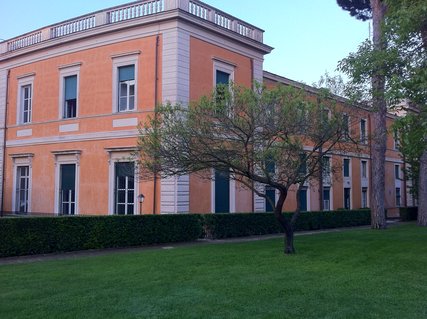
The year was 1977, and this 23-year-old composer arrived wet behind the ears to take up residence at the American Academy in Rome [ed. — designed circa 1912, as he notes, by the Beaux Arts firm of McKim, Mead & White] — home abroad to American artists and scholars since 1913 — as the youngest recipient of the Rome Prize Fellowship in Musical Composition. . . .
The American Academy in Rome (1913) – Architects: McKim, Mead & White
That was also year I came to understand the reasons why “art music” had become the mess it had: A Faustian marriage of Hegelian teleology and apocalyptic 20th-century world wars. [ed. — compare the ideology underlying architectural Modernism; Faust, recall, sold his soul to the devil] For a young composer entering into this world the sanctioned choices felt impossibly narrow. . . .
Here were the rules from the dark heart of 1970s orthodoxy:
No octaves. Ever.
Pre-compositional charting: required.
Never repeat anything.
Nothing linear.
Continuity or atmosphere verboten.
Basically, if you want to sing, join a choir.
Don’t let any revisionist historian tell you otherwise — it was a closed system. The battle lines were clearly drawn: tonality versus atonality, serialization versus alleatoric/open form/conceptualism. . . .
Living for a year in one of the wellsprings of Western Civilization helped me find the courage to look inward, to locate that which was particular to me. Visiting the Brancacci Chapel in Florence, Masaccio’s elemental frescoes rattled me — so stripped of artifice, lyric, human, and bare. How could I find such clarity in my own music? Where could I find notes that spoke the truth? . . .
History is not our enemy: A renaissance Italian architect might have looked at Roman house and said: “here is a form that I can use for my own purposes.” The result would be anything but a copy — but a playful riff on the prevailing orthodoxy. We can always learn from what came before us, but we actually need to look at it.
If you happen to be in Waco, Texas tomorrow October 11, I’m giving a talk at Baylor’s Honors College on “A Monumental Fight: The Eisenhower Memorial and America’s Historical Memory.” Here’s the press release:
WACO, Texas (Oct. 9, 2012) – Justin Shubow, chairman of the National Civic Art Society in Washington, D.C., will be hosted by the Honors College at Baylor University for a lecture on, “A Monumental Fight: The Eisenhower Memorial and America’s Historical Memory.” The event will take place at 7 p.m. Thursday, Oct. 11, in the Alexander Reading Room of Alexander Residence Hall, 1413 S. Seventh St.
Shubow is a leading authority in the field of civic art innovation and preservation. He authored The Gehry Towers Over Eisenhower and has contributed reviews and criticism to numerous publications. In June 2012, he testified to the House Subcommittee on National Parks, Forests and Public Lands on the future of the National Mall.
“We demand an investigation of the memorial planning, competition, design and approval processes,” Shubow said, regarding the subject of his lecture. “Congress must investigate, as must the GSA Office of Inspector General and the General Accounting Office. At the very least, the facts warrant an entirely new competition, one that is open, democratic, inclusive and fair – one that is as open to an unknown designer from Abilene as much as a ‘starchitect’ from L.A.”
The lecture is free and open to the public. For more information, call 254-710-1523.
by Brent Salter, student newswriter, (254) 710-6805
[Published in the October 2012 issue of Vanity Fair.]
To the Editor:
In his article on the growing opposition to the design for the National Memorial to President Dwight D. Eisenhower, Paul Goldberger doubted whether the Eisenhower family’s denunciation of Frank Gehry’s deconstructionist plan should matter at all.
In 1964 the Roosevelt family condemned the modernist design for the F.D.R. Memorial, which was the work of one of the country’s leading architecture firms. Speaking for his family, the president’s eldest son said about the proposed monument, “We don’t like it, and I’m sure father wouldn’t either.” That was good enough to kill it; the architects had the good grace to withdraw their plan.
Likewise, there is no doubt that Eisenhower, who was famous for his modesty, would have hated Gehry’s grandiose design. Disdaining modern art and architecture, which he did not believe represented the taste of the American people, the president said in 1962, “We see our very art forms so changed that we seem to have forgotten the works of Michelangelo and Leonardo da Vinci. . . . What has happened to our concept of beauty and decency and morality?”
Goldberger also makes a telling omission. Despite the thousands of words in his article, he does not defend Gehry’s design. Instead, he merely defends the architect. Whether or not Gehry should gracefully heed the Eisenhower family’s fierce opposition, not to mention the president’s own taste in art, he should listen to what his friends are saying — or pointedly are not.
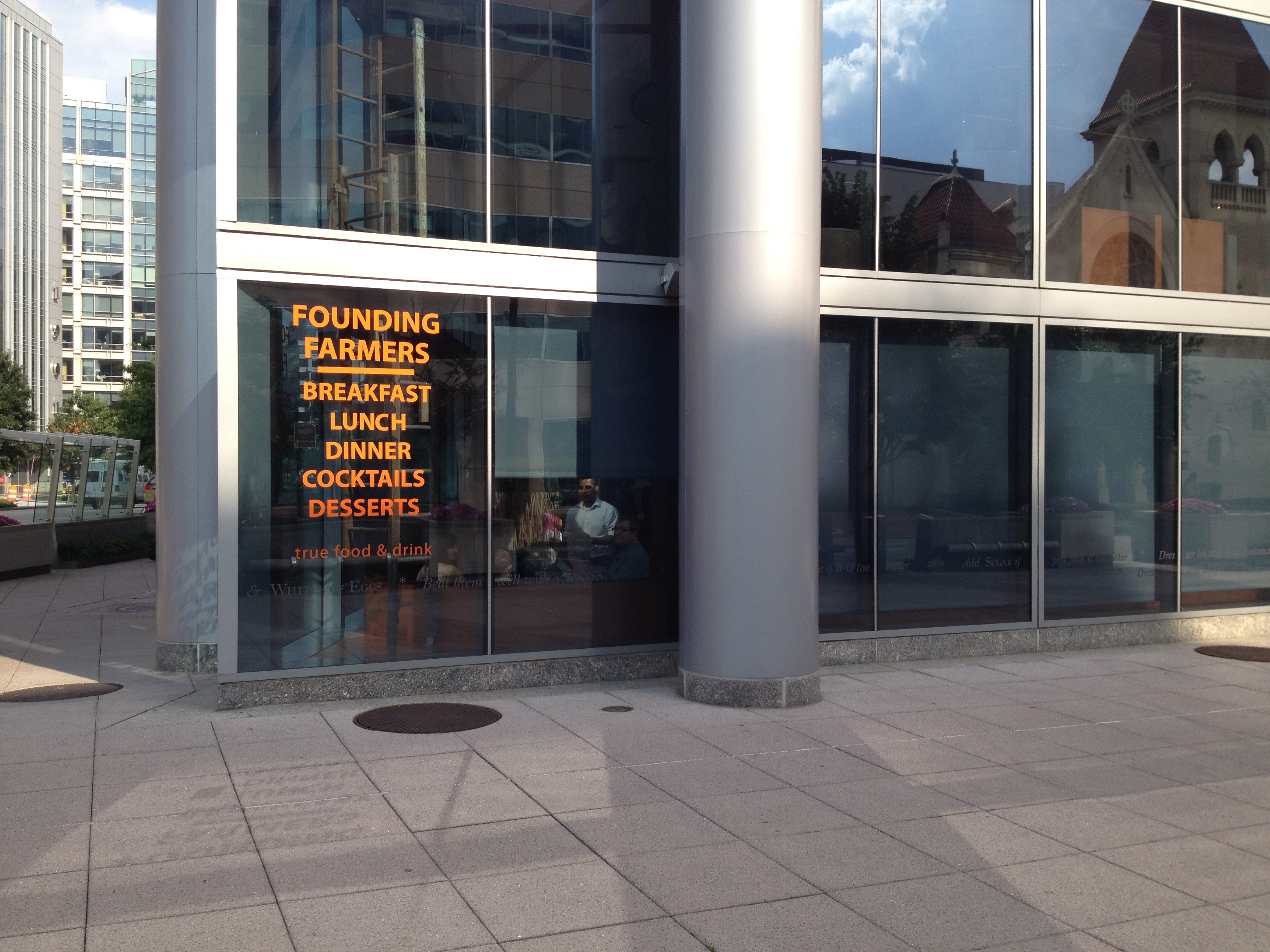
Founding Farmers is one of the most popular, and cleverly named, restaurants in Washington, D.C. According to its self-description, “it is a celebration of the land and the American family farmer; it is a nod to the founding fathers of our country, many of whom owned and farmed land that surrounds Washington, D.C.; and it is a place where true, sustainably farmed, grown and harvested American foods are brought to our guests.” Farm-to-table, slow food — it sounds great!
And when I think of sustainability, family farms, and tradition I think of . . . a metal and glass skyscraper.
Hmm. Sterile and uninviting. That doesn’t tell us much about the restaurant. Let’s try the entrance. Continue reading →
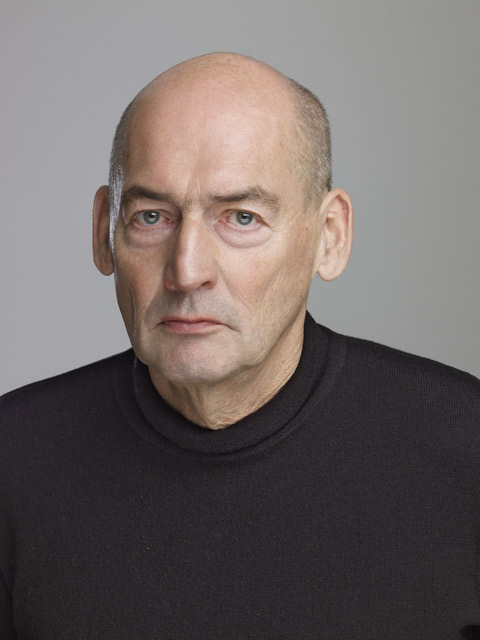
From the August 16, 2006 Spiegelinterview of Dutch architect Rem Koolhass:
SPIEGEL: In methodical Germany, a major debate is currently underway in Berlin over whether to rebuild or start from scratch. Is tearing down the Palace of the Republic the right thing to do, and should the reconstructed Hohenzollern palace (which East German authorities demolished in 1950) really be erected in its place?
Koolhaas: I think tearing down the palace is a crime, simply because it was a special, recognizable artifact of a past political system. In my view, Berlin is nothing but a collection of overlapping regimes. It’s unhealthy in a historical sense to eradicate this characteristic building.
SPIEGEL: But the palace was ugly.
Koolhaas: Ugliness also has a right to exist. Our society can no longer tolerate ugliness. You see that in cars, sofas and women. But seriously, if something like this building is ugly but nevertheless important, we must preserve it.
SPIEGEL: And if it had been beautiful and important? Shouldn’t architects be the prophets of beauty?
Koolhaas: Beauty isn’t what I’m primarily interested in. I think appropriateness is more important.
SPIEGEL: What do you think is the world’s most beautiful building?
Koolhaas: Very conventionally, the Pantheon in Rome, for example. Isn’t it remarkable? Talk about beauty and you get boring answers, but talk about ugliness and things get interesting.
SPIEGEL: What are the greatest architectural sins?
Koolhaas: Evil has many faces. It can also arise both from inability or from malicious intentions.
SPIEGEL: Are you saying that evil and ugliness are the same thing?
Koolhaas: Not necessarily. Evil can also be beautiful. The Coliseum in Rome, for example, a wonderful structure with an awful past. Just think about the bloody gladiator fights there.
In the same interview Koolhass says that “porn” is “the last form of humanism.”
It seems that the currently fashionable architects are competing to plant their “contemporary stamp” on the historic face of the Eternal City. It all began with the completion in 2005 of Richard Meier’s Museum of the Ara Pacis, which seems to have opened the way for new Modernist architecture in the city. Upon its completion, the Meier building prompted protests even from the mayor of Rome, and now its entry plaza is to undergo a makeover in answer to some of the criticisms that met its debut, most notably the wall that blocks the view of two Neo-classical churches from the riverside boulevard of the Lungotevere.
MAXXI Museum by Zaha Hadid. Photo by Steven Semes.
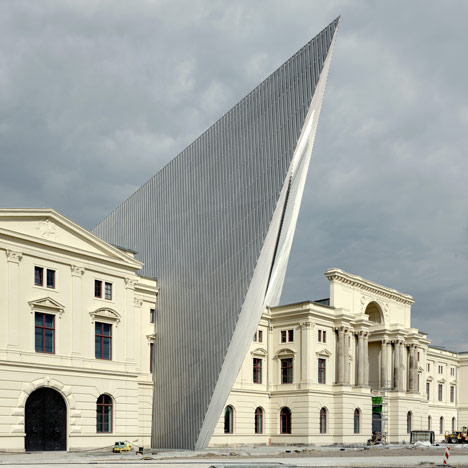
As disturbing as the counter-contextual imposition of Meier’s building is, there is something worse afoot in Rome: the gutting of historic buildings of more recent vintage and their incorporation into crudely cannibalistic new construction. Modernist architects are becoming perversely parasitic in this way: They insist on using historic structures as a “foil” to their unprecedented forms and high-tech materials. Aggressive “shards” and “blobs” are suddenly exploding from the bellies of older buildings like the creature in the movie “Alien” that burst out of the abdomen of an ill-fated earthling. Daniel Liebskind’s Contemporary Jewish Museum in San Francisco and War Museum in Dresden are the best known examples of this approach.
Turning to the example of Zaha Hadid’s MAXXI Museum in Rome, Semes comments:
Hadid uses the existing building simply as a shell, hollows it out, paints it white and makes it all but disappear, nearly overwhelmed by the onslaught of the new structure that seems to be attacking it like some colossal monster in a science-fiction film. But, unexpectedly, the old structure’s dignity of composition, satisfying proportions and human scale resist the architect’s act of appropriation. It stands its ground, still recognizable as architecture, refusing to be destroyed. This persistence must keep Hadid awake at night. Not allowed to demolish the buildings, she is powerless to rob them of their meaning, despite the considerable effort she gives to the task.